

Unknown Supplier: Practical Checks Before Any Payment
Dealing with an unknown supplier can expose your business to fraud, delays, and quality issues. Use this practical framework to verify identity, documents, and payment safety.
Unknown Supplier: Practical Checks Before Any Payment
An unknown supplier can create serious risk long before goods are shipped or services are delivered. The main danger is not only fraud, but also poor documentation, hidden intermediaries, unclear liability, and payment disputes. Before sending money, buyers should verify the supplier’s legal identity, operating history, commercial consistency, and payment process. A structured review helps reduce avoidable losses and supports safer business decisions.
What does an unknown supplier actually mean?
An unknown supplier is not simply a new vendor. It is a supplier whose identity, authority, track record, or transaction conditions cannot yet be confirmed with enough confidence.
In practice, the risk appears when key facts are missing, inconsistent, or impossible to verify independently. That uncertainty matters more than whether the supplier is local, foreign, large, or small.
Typical signs of an unknown supplier include:
- no verifiable company registration
- a website with little history or copied content
- bank or payout details that do not match the business name
- pressure to pay quickly without standard documentation
- inconsistent contact names, domains, or phone numbers
- refusal to provide references, contracts, or product evidence
This distinction is important because many scams imitate legitimate trade behavior. Fraudulent actors often provide invoices, catalogs, certificates, and shipping promises that look professional at first glance.
A buyer should therefore assess four dimensions:
- legal existence
- commercial credibility
- operational capacity
- payment security
If one of these pillars is weak, the transaction deserves deeper review before any commitment is made.
New supplier vs risky supplier
A new supplier is not automatically unsafe. Many legitimate businesses are young, recently incorporated, or entering export markets for the first time.
The issue is whether the supplier can support its claims with consistent evidence. A legitimate new company can still provide registration documents, named directors, product records, and clear contractual terms.
Why paying an unknown supplier is risky
Paying an unknown supplier creates exposure at several levels. Even when fraud is not involved, weak verification can lead to delayed delivery, non-compliant goods, customs problems, or disputes over specifications.
The most common risks include:
- advance payment fraud
- counterfeit or substituted products
- fake logistics documents
- unauthorized resellers posing as manufacturers
- hidden insolvency or dormant companies
- contract terms that are impossible to enforce
- identity theft using a real company’s name
Operational risk is often underestimated. A supplier may exist legally but still lack the capacity to fulfill the order, maintain quality standards, or comply with import rules.
Financial risk also extends beyond the initial payment. If goods arrive defective, incomplete, or materially different from what was agreed, the buyer may face replacement costs, production delays, legal fees, and reputational damage.
This is why supplier verification should happen before discussing payment timing. Once a transaction is rushed into execution, the buyer loses leverage.
A safer process usually includes:
- supplier due diligence before order confirmation
- written specifications and acceptance criteria
- documented identity checks
- a secured payment flow
- clear evidence of delivery and compliance
How to verify an unknown supplier step by step
The best way to assess an unknown supplier is to use a repeatable checklist. Verification should rely on independent sources, not only on documents sent by the supplier.
Start with identity and registration. Then move to commercial proof, product proof, and transaction structure.
Use this practical sequence:
- confirm the legal company name exactly as registered
- check the registration number in the relevant official registry
- verify the registered address and compare it with invoices and website details
- identify directors, officers, or beneficial owners where available
- review the website domain age and business email consistency
- request a pro forma invoice and compare all legal details
- ask for references, recent shipment evidence, or customer case examples
- verify product certifications directly with issuing bodies when relevant
- confirm who is actually manufacturing, stocking, or shipping the goods
- review the contract, delivery terms, and dispute clauses before payment
A mismatch does not always mean fraud. But each mismatch increases uncertainty and should be resolved before moving forward.
Check legal identity first
Look for official records, not screenshots. A certificate of incorporation is useful, but it should be matched against a government or recognized business registry whenever possible.
Pay attention to exact spelling, legal form, and status. A dissolved, struck-off, or dormant company should trigger immediate caution.
Check commercial consistency
The company name should match across the website, email footer, quotation, invoice, and registration documents. If the supplier asks you to contract with one entity but pay another, ask for a documented explanation.
Also review whether the supplier’s product range makes commercial sense. A company claiming to sell unrelated high-risk goods with no visible specialization may require deeper scrutiny.
Check product and fulfillment evidence
Ask for dated product photos, packaging details, serial references, compliance documents, and sample procedures. If the supplier claims to be a manufacturer, request factory details and evidence that can be independently checked.
For larger orders, consider third-party inspection, sample validation, or a video call showing inventory, equipment, or production lines.

Illustration pour "How to verify an unknown supplier step by step"
Red flags that an unknown supplier may be fraudulent
Some warning signs appear repeatedly in supplier fraud cases. One red flag alone may not be decisive, but several together should stop the transaction until clarified.
Common red flags include:
- unusually low pricing compared with market norms
- urgent requests for same-day payment
- free email addresses instead of company domains
- recent domain registration with little business footprint
- poor-quality contracts with copied legal language
- refusal to provide live verification or traceable references
- sudden changes in beneficiary or payout details
- invoices from one company and shipping promises from another
- pressure to avoid normal procurement controls
- inconsistent grammar, signatures, or contact identities across messages
Fraud can also involve impersonation. In these cases, the supplier may use the name of a real company, but the email domain, phone number, or beneficiary details belong to a different actor.
That is why buyers should independently source contact details from official websites or registries. Never rely only on the contact information contained in an incoming email chain.
Behavioral red flags during negotiation
Watch how the supplier reacts to normal due diligence. Legitimate businesses may be slow or incomplete, but they usually understand why buyers request verification.
A fraudulent or deceptive supplier often tries to create urgency, discourage questions, or frame standard checks as distrust.
Documents to request from an unknown supplier
Documents do not guarantee legitimacy, but they help test consistency. The goal is to compare documents against each other and against independent sources.
Useful documents to request include:
- certificate of incorporation or business registration extract
- tax or VAT registration where applicable
- proof of business address
- director or authorized signatory information
- product specifications and technical sheets
- quality or compliance certificates
- recent commercial invoice or pro forma invoice template
- export licenses if the goods are regulated
- insurance certificates where relevant
- references or purchase order examples with sensitive data redacted
When reviewing documents, check:
- dates and validity periods
- exact legal entity name
- registration numbers
- issuing authority details
- formatting consistency
- whether signatures and stamps appear generic or copied
If the supplier refuses basic documentation for a transaction involving significant value, that alone may justify pausing discussions.
Which documents matter most?
Prioritize documents tied to legal identity and transaction execution. Registration records, invoices, contracts, and product compliance documents usually matter more than marketing brochures.
For regulated sectors, certification and authorization checks become critical. Always verify certificates with the issuing body when possible.
How to structure payment safely with an unknown supplier
When dealing with an unknown supplier, payment structure is as important as supplier verification. A weak payment process can turn a manageable risk into a costly loss.
The safest approach is to avoid informal transfers based only on email instructions. Buyers should use documented terms, clear milestones, and a secured payment flow.
A prudent payment setup often includes:
- a signed agreement or accepted order with clear specifications
- identity checks completed before payment initiation
- matching legal entity and payout details
- documented delivery or performance conditions
- traceable communication and approval records
- payment services provided by Stripe through a technical intermediation platform
TrustProtect operates as a technical intermediation platform for secure peer-to-peer transactions. It does not provide payment services itself; payment services are provided by Stripe through Stripe Connect Express.
This matters because buyers need both transaction clarity and a reliable process layer. A secured payment flow can help organize documentation, milestones, and counterpart verification around the transaction.
Below is a comparison of common approaches:
| Payment approach | Main advantage | Main risk | Best use case |
|---|---|---|---|
| Direct bank transfer after invoice | Fast and familiar | High exposure if supplier is unverified | Only with established, verified suppliers |
| Partial upfront payment with contract | Shares risk if terms are clear | Still exposed if identity or delivery is weak | Medium-trust transactions with evidence |
| Secured payment flow via technical intermediation platform | Better documentation, process control, and traceability | Requires setup and compliance by both parties | New or higher-risk counterparties |
The right question is not only "How do I pay?" but also "What conditions must be met before I pay?"
What to confirm before initiating payment
Before payment is initiated, confirm the legal entity name, amount, currency, delivery terms, and the exact trigger for payment. All of these should appear consistently in the order documents.
Also confirm who is responsible for shipping, customs documentation, and acceptance criteria. Ambiguity at this stage often leads to disputes later.
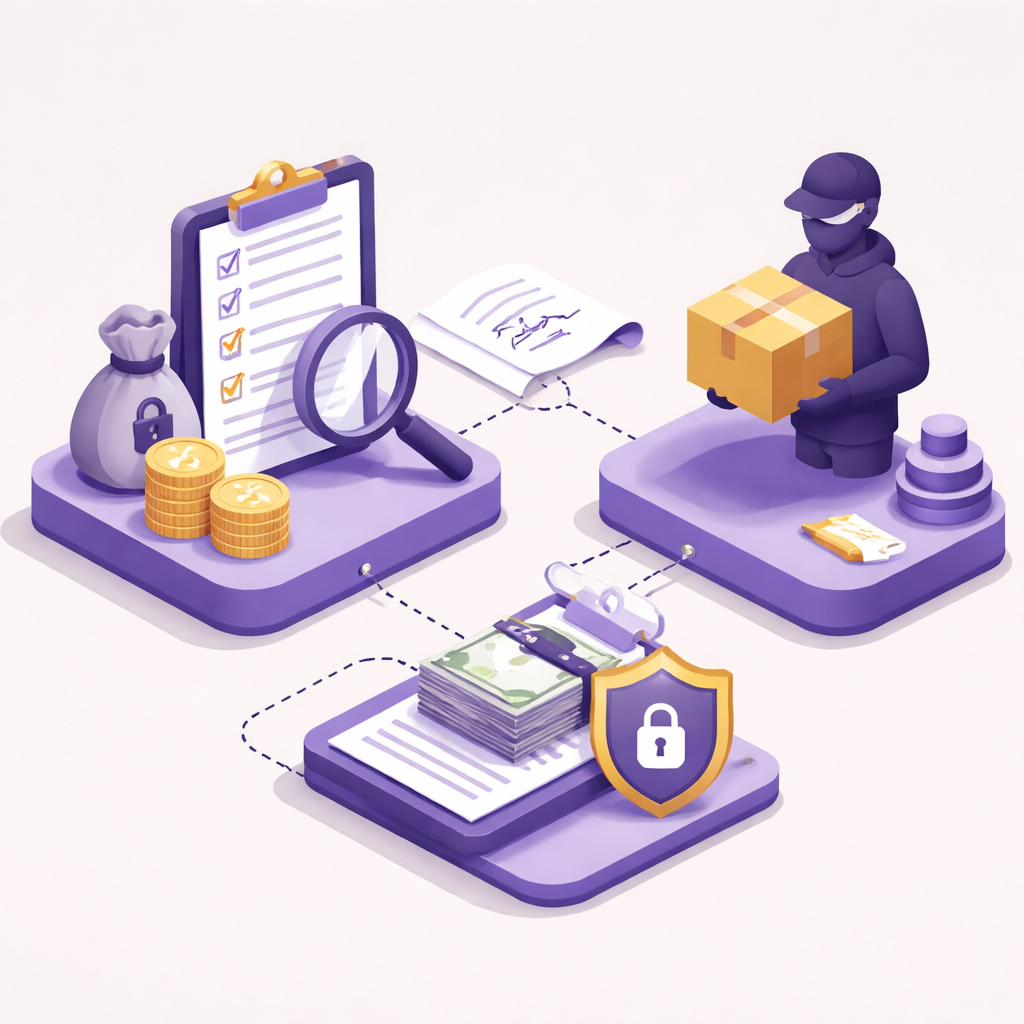
Illustration pour "How to structure payment safely with an unknown supplier"
Contract terms that protect you from supplier disputes
A clear contract reduces uncertainty when working with a new or unknown supplier. It should define what is being sold, by whom, under which standards, and what happens if performance fails.
Essential clauses often include:
- full legal names of the parties
- product or service specifications
- quantity, tolerances, and quality standards
- delivery timetable and location
- inspection and acceptance procedure
- documentation required before shipment or completion
- liability for defects or non-conformity
- refund, replacement, or corrective action terms
- governing law and dispute resolution process
- sanctions, export control, and compliance representations
A contract should also address communication authority. Specify who can approve changes, issue instructions, or modify delivery and payment details.
This is especially important in impersonation scenarios. Fraud often succeeds because buyers rely on informal email requests that were never authorized under the contract.
What businesses should do if they already paid an unknown supplier
If you have already paid an unknown supplier, act quickly and preserve evidence. Delay can reduce your options for investigation, recovery, and internal reporting.
Take these steps immediately:
- stop any further payments or amendments
- preserve emails, invoices, contracts, and chat messages
- document the timeline of events and all payment references
- contact your finance, legal, and procurement teams
- verify whether the supplier identity was genuine or impersonated
- notify the platform or service used in the transaction flow
- report suspected fraud to relevant authorities where appropriate
- review internal controls to prevent repeat incidents
If payment services were provided by Stripe within a secured payment flow, gather all transaction identifiers and supporting documents before contacting the relevant support channels. The quality of your records can materially affect how efficiently the case is reviewed.
Do not continue negotiating informally if serious inconsistencies have emerged. Once fraud indicators are present, every new message should be treated as evidence.
Internally, conduct a post-incident review covering:
- vendor onboarding failures
- approval workflow gaps
- document verification weaknesses
- communication channel vulnerabilities
- payment authorization controls
A practical checklist before working with any unknown supplier
A short checklist helps teams make consistent decisions. It is especially useful for procurement, operations, and finance teams that need a shared standard.
Use this pre-payment checklist for any unknown supplier:
- legal entity verified in an official or reliable registry
- address, directors, and status confirmed
- website domain and business email reviewed
- invoice details match the legal entity
- product legitimacy and capacity checked
- references or transaction history reviewed
- contract signed with clear specifications
- delivery and acceptance criteria documented
- payout details verified through an independent channel
- secured payment flow selected where appropriate
- internal approval recorded before payment
This checklist should be adapted to transaction size and sector. A low-value order may require lighter checks, while regulated goods, cross-border trade, or custom manufacturing require deeper review.
The key is proportionality. Stronger risk means stronger verification.
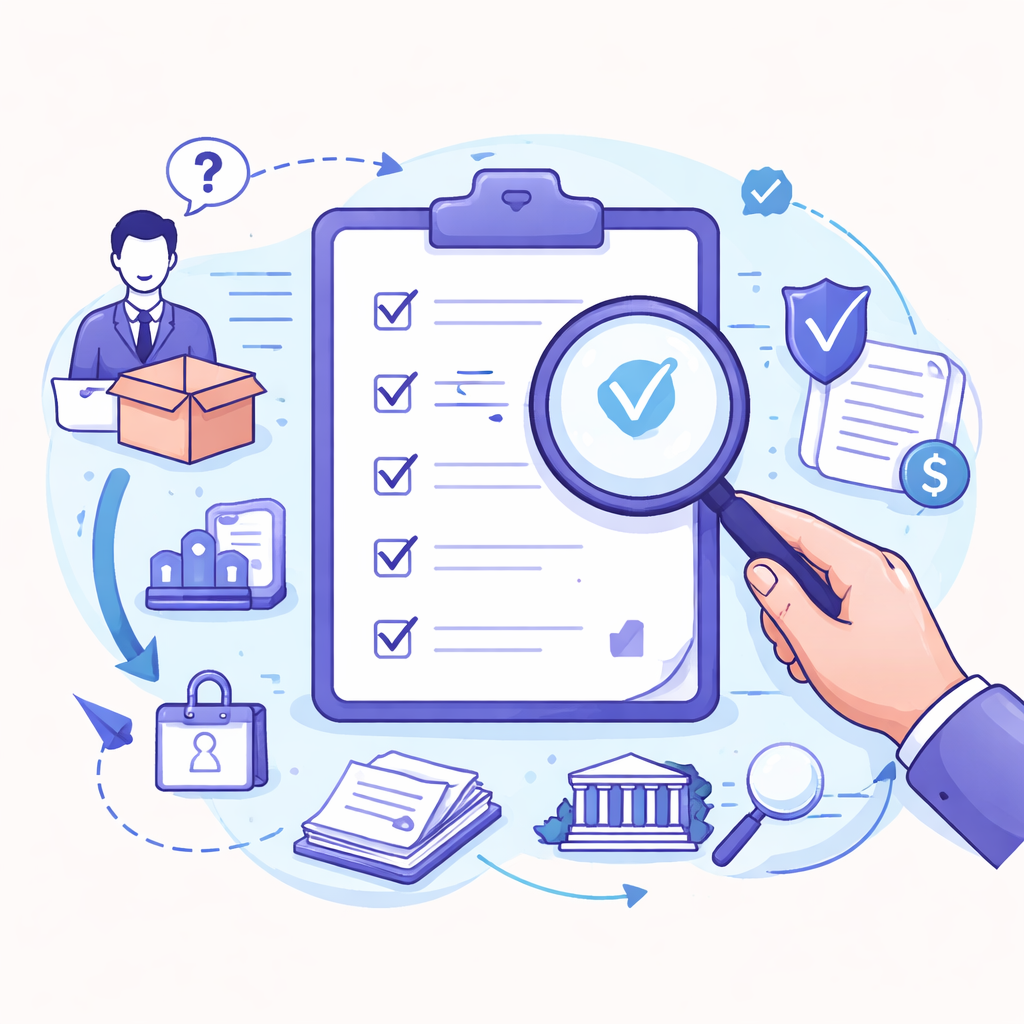
Illustration pour "A practical checklist before working with any unknown supplier"
Questions fréquentes
How do I know if an unknown supplier is legitimate?
Start by verifying the supplier’s legal identity, registration status, address, directors, and business contact details through independent sources. Then compare those details with invoices, contracts, website information, and product documentation. A legitimate supplier should show consistent information across all of these points.
Is it safe to pay an unknown supplier upfront?
Paying upfront to an unknown supplier is higher risk, especially if identity, product legitimacy, and fulfillment capacity are not yet verified. If advance payment is unavoidable, use clear contractual milestones, documented conditions, and a secured payment flow. Never rely only on email assurances.
What are the biggest red flags with a new supplier?
Major red flags include unusually low prices, urgency to pay, mismatched company and payout details, refusal to provide verifiable documents, and last-minute changes to payment instructions. Another serious warning sign is when the supplier cannot be confirmed through official records or independent references.
What documents should I ask from an unknown supplier?
Request business registration documents, tax or VAT details, invoices, product specifications, compliance certificates, and proof of authority for the signatory. For regulated goods, verify certifications directly with the issuing body. Documents should be checked for consistency, not accepted at face value.
Can a real company still be an unknown supplier?
Yes. A real company can still be an unknown supplier if you cannot verify its authority, capacity, product legitimacy, or transaction terms. Legal existence alone does not prove that the specific deal is safe.
What should I do if the supplier changes payment details?
Treat any change in payment details as a high-risk event. Pause the transaction and verify the change through an independent communication channel using trusted contact details. Do not approve new instructions based only on the same email thread.
How can a technical intermediation platform help with supplier risk?
A technical intermediation platform can support transaction structure, documentation, traceability, and a secured payment flow. In TrustProtect’s case, payment services are provided by Stripe, while the platform helps organize secure peer-to-peer transaction steps. This can improve process control, but it does not replace supplier due diligence.
Conclusion
Working with an unknown supplier does not always mean you should walk away. It means you should slow down, verify facts independently, document the transaction properly, and avoid informal payment behavior.
The safest decisions come from combining supplier due diligence with clear contracts and a secured payment flow. TrustProtect supports secure peer-to-peer transactions as a technical intermediation platform, while payment services are provided by Stripe.
Before proceeding, remember this checklist:
- verify the legal entity and business status
- confirm documents against independent sources
- check product legitimacy and fulfillment capacity
- use clear contractual terms and acceptance criteria
- validate payout details through a separate channel
- choose a process that supports traceability and control
A disciplined review process turns uncertainty into measurable risk. That is the right way to approach any unknown supplier before money changes hands.
Protect your next transaction with TrustProtect
Payment held by Stripe until validation. Buyer protected, seller paid upon validation.
Create a free accountReady to secure your next transaction?
TrustProtect organizes a secure journey between buyer and seller. Payment via Stripe, validation on the platform.