
How to Verify a VIN Number for Free Before Buying a Car
A free VIN check can reveal theft records, recalls, title issues, and mismatched vehicle details. Here is how to verify a VIN number for free using reliable sources.
How to Verify a VIN Number for Free Before Buying a Car
How to verify a VIN number for free starts with knowing where to find the VIN and which databases can confirm whether the vehicle details are legitimate. A free check will not always replace a full vehicle history report, but it can quickly uncover red flags such as recalls, title branding, or mismatched specifications. If you are buying a used car, motorcycle, or truck, this step should happen before payment, inspection, or paperwork. Using official and reputable VIN lookup sources helps you reduce fraud risk and make a more informed decision.
What how to verify a VIN number for free really means
When people search how to verify a VIN number for free, they usually want to confirm that a vehicle is real, correctly described, and not hiding obvious problems. In practical terms, VIN verification means checking both the physical VIN on the vehicle and the digital records attached to it.
A VIN, or Vehicle Identification Number, is a unique 17-character code assigned to most vehicles made after 1981. It can help identify the manufacturer, model year, assembly plant, and certain equipment details.
A free VIN check can help you answer basic questions such as:
- Does the VIN format look valid?
- Does the VIN match the make, model, and year being advertised?
- Is the vehicle listed with open recalls?
- Has it been reported stolen in available databases?
- Do the title and registration appear consistent with the vehicle?
What a free check usually cannot provide is the full depth of a paid vehicle history report. For example, some accident records, insurance claims, service entries, auction data, and ownership timelines may only appear in commercial databases.
If you are dealing with a private seller, this step matters even more. A seller can describe a vehicle however they want, but the VIN creates a factual reference point you can test against documents and public records.
What a VIN can tell you at a glance
A VIN is not just a random serial number. Different sections of the code identify the manufacturer, vehicle attributes, model year, and production sequence.
With a reliable vin lookup tool, you can often confirm:
- Manufacturer and brand
- Body style and engine type
- Model year
- Assembly plant
- Production serial number
If the seller says the car is one trim level but the VIN decodes to another, that is a sign to investigate further.
Where to find the VIN on the vehicle and paperwork
Before using any vin check free service, make sure you have the correct VIN. One wrong character will produce inaccurate results or no result at all.
The VIN is usually visible in several places. You should compare all of them rather than relying on only one location.
Common VIN locations include:
- On the dashboard near the windshield on the driver side
- On the driver-side door jamb sticker or plate
- On the vehicle title
- On the registration document
- On the insurance card or policy paperwork
- In some cases, on the engine bay or frame
The most important rule is consistency. The VIN on the dashboard should match the VIN on the door sticker and the VIN on the title and registration.
How to read the VIN correctly
A standard VIN has 17 characters and uses both letters and numbers. The letters I, O, and Q are typically excluded because they can be confused with 1 and 0.
When copying the VIN:
- Photograph it directly from the dashboard plate
- Compare each character with the title and registration
- Avoid relying on handwritten notes from the seller
- Double-check characters such as 5 and S, or 2 and Z
A clean photo is often the easiest way to avoid transcription mistakes.
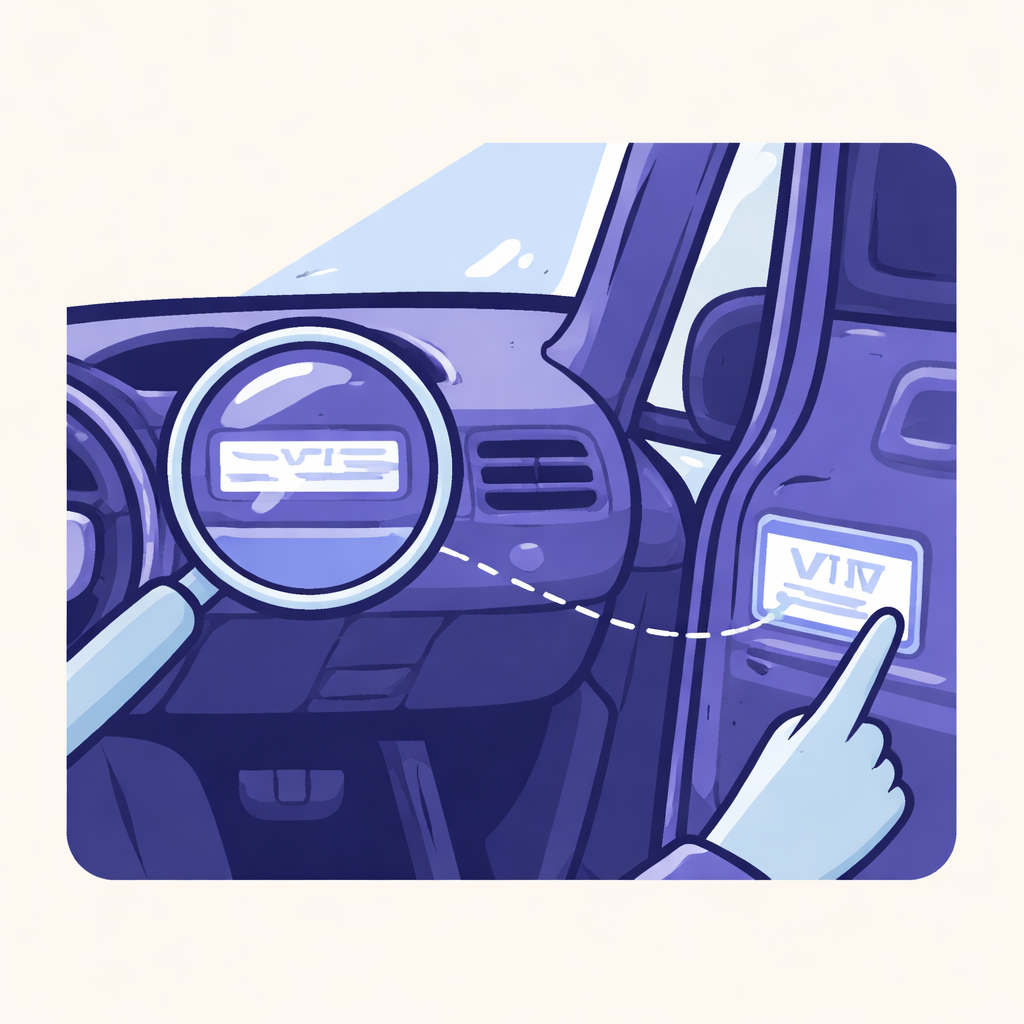
Illustration pour "Where to find the VIN on the vehicle and paperwork"
Step-by-step: how to verify a VIN number for free
The safest approach is to verify the VIN in layers. Start with the physical vehicle, then move to official databases, then compare the results with the seller's claims.
Use this process before you negotiate price or send any money.
- Locate the VIN on the dashboard and door jamb.
- Compare it with the title, registration, and insurance paperwork.
- Confirm the VIN has 17 characters and no invalid letters.
- Run it through a trusted vin lookup tool.
- Check recall information through the NHTSA database.
- Check theft records using the NICB VINCheck service where available.
- Compare decoded details with the listing description.
- Ask the seller about any inconsistency immediately.
This process helps you verify the identity of the vehicle before you move on to a mechanic inspection or a full vehicle history report.
What to compare after the VIN is decoded
Once the VIN is decoded, compare the results against the listing and the vehicle in front of you. This is where many hidden issues become easier to spot.
Check whether these details align:
- Make and model
- Model year
- Engine size or fuel type
- Body style
- Trim or drivetrain when available
- Country of manufacture
If the ad says 2020 but the VIN decodes to 2018, that is not a minor issue. It changes value, financing, insurance, and resale expectations.
Best free sources for a vin check free search
Not all free VIN tools provide the same type of information. Some are best for recalls, others for theft records, and others for basic vehicle decoding.
The smartest approach is to combine several sources rather than trust a single website.
Official and reputable free VIN sources
Here are the most useful places to start:
- NHTSA VIN Decoder: Confirms basic vehicle specifications and open safety recalls in the United States.
- NICB VINCheck: Helps identify whether a vehicle has been reported stolen or marked as salvage by participating insurers, where available.
- Manufacturer recall lookup pages: Some automakers provide VIN-specific recall information directly.
- State DMV or government resources: Some states offer title, branding, or registration-related information.
- Reputable automotive marketplaces: Some listing platforms provide limited free history summaries.
These tools are useful because they rely on official or widely recognized data sources. They are especially helpful when you want to verify a seller's claims quickly.
Comparison table: what free VIN tools usually show
| Tool type | Typical free data | Best use case | Limits |
|---|---|---|---|
| NHTSA VIN decoder | Vehicle specs, recalls | Confirm make, model, year, safety recalls | Not a full ownership or accident history |
| NICB VINCheck | Theft and some salvage records | Screen for major fraud risks | Coverage depends on reporting participation |
| Manufacturer recall page | Brand-specific recall status | Double-check open recalls | Limited to recall information |
| Marketplace summary tools | Basic history flags | Fast first-pass screening | Data depth varies widely |
| State DMV resources | Title or registration info in some cases | Local verification | Availability differs by state |
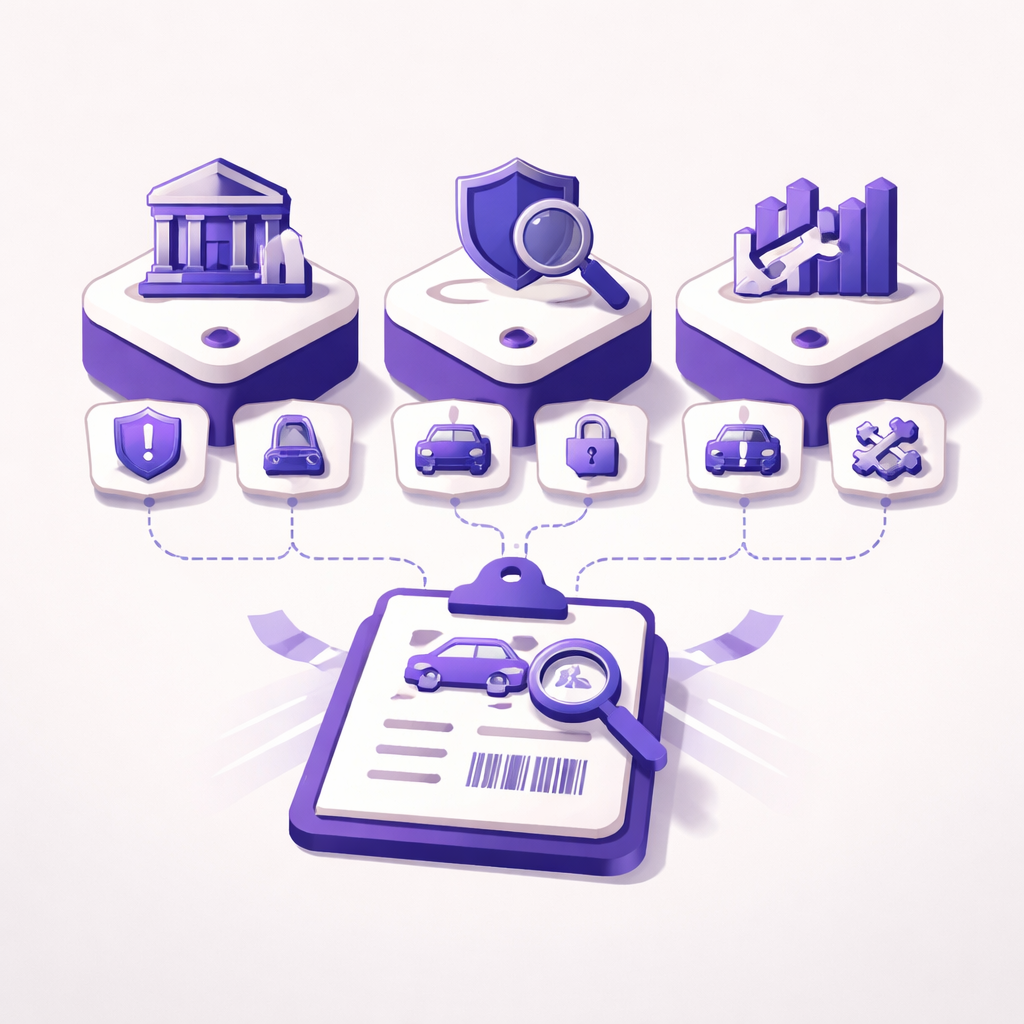
Illustration pour "Best free sources for a vin check free search"
How a free VIN lookup differs from a full vehicle history report
A free VIN search can tell you a lot, but it has limits. That is why buyers often use a free check first and then decide whether a paid report is worth the cost.
A full vehicle history report may include data from auctions, insurers, repair networks, emissions records, title transfers, mileage logs, and prior listings. Free tools usually show only a narrower slice of that history.
Here is the practical difference:
- A free VIN check helps verify identity and obvious red flags.
- A paid report may reveal patterns over time.
- A mechanic inspection shows the current physical condition.
You should think of these as complementary, not interchangeable.
When a paid report becomes worth it
A paid report makes more sense when:
- The vehicle is expensive
- The seller is private and unknown to you
- The car has unusually low mileage for its age
- The title history seems complex
- The vehicle came from another state or auction
- You notice signs of repainting, repairs, or replaced panels
If the deal is significant, the cost of a report is small compared with the cost of buying the wrong vehicle.
Red flags to watch for when using a vin lookup tool
VIN verification is most useful when you know what problems to look for. A decoded VIN is only the beginning; the real value comes from spotting inconsistencies.
Some red flags are obvious, while others only become visible when you compare documents, the listing, and the physical car.
Common warning signs
Pay close attention to these issues:
- The VIN on the dashboard does not match the door sticker
- The title shows a different VIN than the vehicle
- The seller refuses to share the VIN before meeting
- The decoded model year differs from the ad
- The trim, engine, or body style does not match the VIN data
- The VIN plate looks scratched, loose, or tampered with
- The title includes salvage, rebuilt, flood, or other branding not disclosed in the ad
- The seller pressures you to skip verification
Any one of these signs deserves follow-up questions. Several together should make you walk away.
Physical signs of VIN tampering
Look closely at the VIN plate and surrounding area. Uneven rivets, fresh adhesive, scratches, or signs that a plate was removed can indicate tampering.
Also inspect the door label. If it looks newer than the surrounding paint or appears to have been peeled and replaced, ask why. A legitimate repair may have an explanation, but the explanation should be documented.
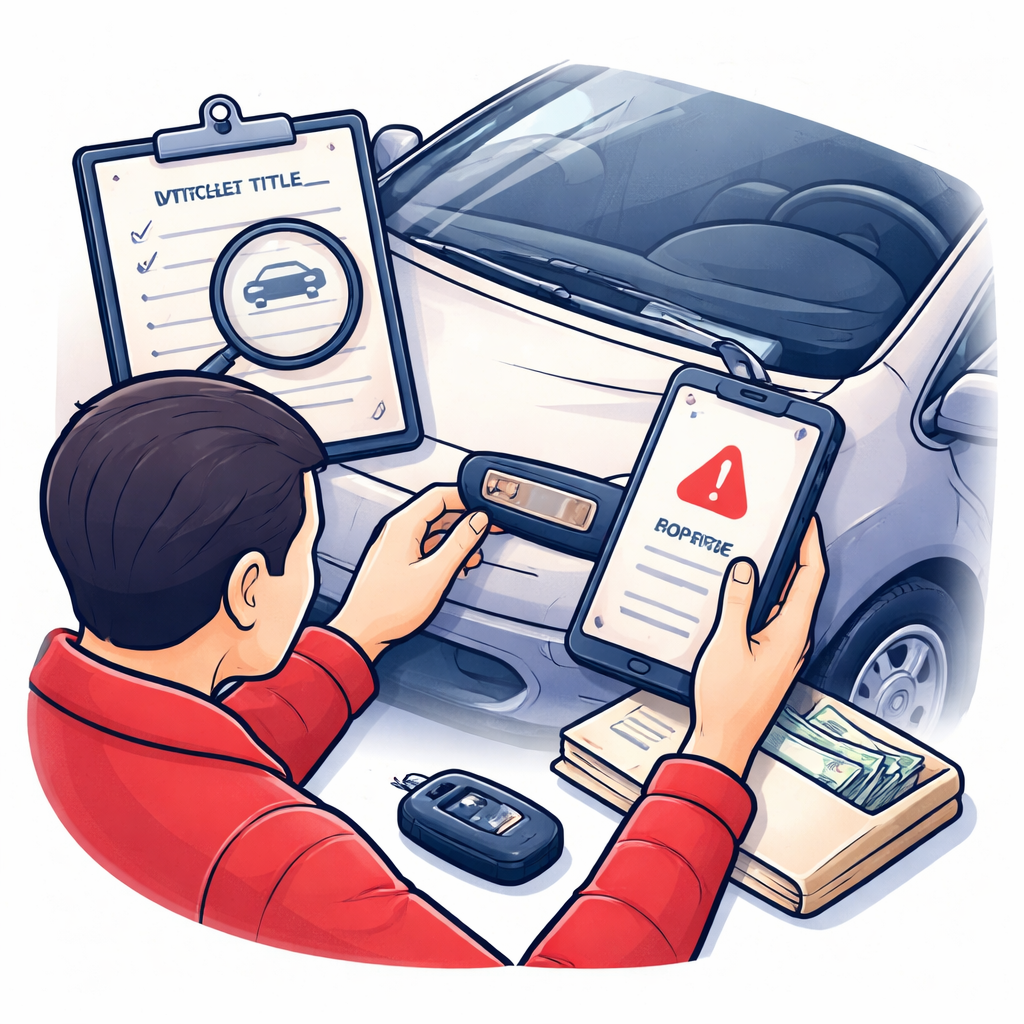
Illustration pour "Red flags to watch for when using a vin lookup tool"
Using how to verify a VIN number for free when buying from a private seller
Private-party transactions carry more risk because there is usually less formal screening than at a dealership. That does not mean you should avoid them, but it does mean you need a more disciplined process.
Start with the VIN before you discuss deposits, shipping, or meeting locations. If the seller hesitates to provide it, treat that as a warning sign.
A practical buyer checklist includes:
- Ask for the VIN in writing before meeting
- Run a free VIN check through official sources
- Compare the VIN to the title and registration in person
- Verify the seller's name matches the title
- Inspect the car in daylight
- Get an independent mechanic inspection
- Avoid sending money before verification is complete
If the transaction is remote, ask for a live video walkaround that includes the dashboard VIN, door sticker, odometer, and title. This does not replace in-person inspection, but it can reduce obvious fraud risk.
For the payment stage, use a secure process with clear identity checks, documented terms, and a traceable transaction flow. On platforms such as TrustProtect, payment services are provided by Stripe as part of a secured payment flow for peer-to-peer transactions.
Questions to ask the seller after a free VIN check
Once you have basic VIN results, ask direct questions:
- Why are you selling the vehicle?
- How long have you owned it?
- Is the title clean and in your name?
- Has the vehicle ever been in an accident or flood?
- Are there any open recalls?
- Can I see maintenance records and inspection receipts?
The goal is not just to collect answers. It is to see whether the answers remain consistent with the VIN data and the condition of the vehicle.
Limits of free VIN verification and when to involve experts
Even if you know how to verify a VIN number for free, there are situations where free tools are not enough. Complex title histories, imported vehicles, rebuilt cars, and older vehicles may require deeper research.
A VIN check also cannot tell you everything about mechanical condition. A car can have a clean VIN record and still need major repairs.
Consider extra help when:
- The vehicle has a rebuilt or salvage title
- The seller cannot explain title gaps
- The vehicle was imported or exported
- The odometer reading seems suspicious
- The car shows signs of major body repair
- The price is far below market value
In these cases, combine VIN verification with:
- A professional pre-purchase inspection
- A full title review
- A paid history report
- Direct confirmation from the DMV or relevant authority
This layered approach is usually cheaper than dealing with fraud, registration problems, or hidden repairs after the sale.
Why inspection still matters after a clean VIN result
A VIN check verifies identity and available records. It does not inspect brakes, suspension, transmission wear, frame alignment, or hidden water damage.
That is why serious buyers use both record-based checks and physical inspection. One protects you from paperwork and identity issues, while the other protects you from condition-related surprises.
Simple checklist to verify a VIN before you buy
If you want a fast process, use this checklist every time. It covers the minimum steps a buyer should take before committing to a used vehicle.
Free VIN verification checklist:
- Find the 17-character VIN on the dashboard
- Match it to the door jamb sticker
- Match it to the title and registration
- Decode it with a trusted vin lookup tool
- Check NHTSA for recalls
- Check NICB for theft or salvage indicators where available
- Compare decoded details with the seller's listing
- Look for signs of VIN plate tampering
- Ask the seller about any mismatch
- Get an inspection before finalizing the purchase
This checklist is simple, but it catches many of the most common problems in used-car transactions.
Questions fréquentes
Can I verify a VIN number for free online?
Yes, you can verify a VIN number for free online using sources such as the NHTSA VIN decoder, manufacturer recall pages, and NICB VINCheck where available. These tools can help confirm vehicle identity, recalls, and some theft or salvage records, but they do not always replace a full vehicle history report.
What is the best free VIN check website?
The best free source depends on what you need to confirm. NHTSA is strong for vehicle specs and recalls, while NICB is useful for theft and some salvage screening. In practice, the best approach is to use more than one vin lookup tool.
Does a free VIN check show accident history?
Sometimes, but not consistently. A free VIN check may show limited damage-related flags if they were reported to a participating database, but many accident records only appear in commercial reports. That is why buyers often start with a free check and then order a full vehicle history report if needed.
How do I know if a VIN is fake or altered?
Check whether the VIN has 17 characters, uses valid formatting, and matches across the dashboard, door sticker, title, and registration. Also inspect the VIN plate for scratches, loose rivets, or signs of replacement. If the records and physical markings do not align, treat the vehicle as high risk.
Can a VIN tell me the exact car model and year?
Yes, a decoded VIN can usually confirm the manufacturer, model year, and many core vehicle attributes. Depending on the database, it may also identify body style, engine type, and assembly plant. This is one reason how to verify a VIN number for free is such an important first step for used-car buyers.
Is a free VIN check enough before buying a used car?
Not always. A free check is excellent for screening obvious issues, but it should be combined with document review and a mechanical inspection. For higher-value purchases or suspicious listings, a paid vehicle history report is often worth the extra cost.
What should I do if the VIN on the title does not match the car?
Do not proceed with the transaction until the issue is resolved by the seller and, if necessary, the DMV or another competent authority. A VIN mismatch can indicate a clerical mistake, title problem, or fraud. In most cases, it is safer to walk away than to assume it will be fixed later.
Conclusion
Knowing how to verify a VIN number for free gives you a practical way to reduce risk before buying a used vehicle. It helps confirm that the car exists as described, that the paperwork matches, and that obvious issues such as recalls or theft records are not being ignored.
A free VIN check works best when you use it as part of a broader review. Verify the VIN on the car, compare it to the title and registration, run official database checks, and follow up with an inspection if the vehicle is worth serious consideration.
Before you buy, remember this checklist:
- Match the VIN across the vehicle and documents
- Use more than one vin lookup tool
- Check recalls and theft databases
- Compare decoded details to the listing
- Treat mismatches as serious warnings
- Add a mechanic inspection and, when needed, a full vehicle history report
If you follow these steps, how to verify a VIN number for free becomes more than a search query. It becomes a simple due-diligence habit that can save you from expensive mistakes.
Protect your next transaction with TrustProtect
Payment held by Stripe until validation. Buyer protected, seller paid upon validation.
Create a free accountReady to secure your next transaction?
TrustProtect organizes a secure journey between buyer and seller. Payment via Stripe, validation on the platform.